Christians Should Be Radically Ambitious From a Place of Radical Non-Necessity
• 4 min read
I.
Turn the other cheek has come to imply a doormat-like quality that has made the Christian way seem cowardly and complicit in the face of injustice.
Walter Wink, Nonviolence for the Violent
What if "turn the other cheek" means something different? In the Book of Matthew, Jesus specifies the right cheek:
If anyone slaps you on the right cheek, turn to them the other cheek also.
Matthew 5:39
Theologian Walter Wink notes using the right hand to strike the right cheek necessitates a backhand, reserved for the lowest of the low in Jewish society:
By turning the cheek then, the inferior party is saying “I’m not inferior to you. I’m a human being. I refuse to be humiliated any longer. I am your equal. I’m a child of God. I won’t take it anymore.”
His explanation is that this simple act forces the oppressor to acknowledge an identity (human being, equal, child of God). The way we understand ourselves is inextricably linked with how we move and act within this world.
II.
Ordinary ambition presents a bargain: achieve enough, gain enough status, have a black enough AmEx card, have a 50-year mortgage in the right zip code and you might finally deserve to feel at home in your life.
Identity is normally earned through performance. Christianity reverses this order: God bestows identity before achievement.
In fact, any and all achievements are unable to secure this identity. In Christ, our adoption into a family is a love we could never earn, granted by grace and grace alone.
Michael Heiser discusses what it means to be an image of God:
Being created as God’s imagers means we are His representatives on earth—the only qualification for this is that we are human.
This view means that all human endeavor and enterprise has spiritual meaning—work is a spiritual exercise. Vocation is worship, no matter how mundane. Any task performed to steward creation, to harness its power for God’s glory and the benefit of fellow imagers, and to foster in the harmonious productivity of fellow imagers, is imaging God. This application of the image has been referred to as the “cultural mandate” or the vocational view of the imago Dei (Sands, “The Imago Dei as a Vocation”).
Michael Heiser, Image of God
To bear the image of God is to represent Him. Identity carries responsibility. Work is the fulfillment of a spiritual calling.
Paul gives this work its orientation:
Whatever you do, work at it with all your heart, as working for the Lord, not for human masters.
Colossians 3:23, NIV
III.
As a Christian, you are supposed to be radically ambitious from a position of radical non-necessity.
In what many refer to as the "greatest chapter in the Bible," Paul says nothing in creation can separate us from the love of Jesus. After all:
If God is for us, who can be against us?
Romans 8:31
Success cannot confer the identity of an heir and son of God; likewise, nor can hunger, persecution, death, even failure revoke it. Does an heir to an inheritance fear being laid off a mistake?
Our eternal security frees us to attempt more. Because our identity is not determined on achievements, we can risk, strive, build, and endure past the point where a striver would quit; the striver's self is riding on the outcome and ours is not.
"Inputs over outputs" gets at an important part of this. We may be indifferent to the outputs because of our secure identity, but this identity as a steward means we do not stay content with brainrot AI slop doom feeds, but instead we work and channel our ambition toward the will of the principal, as imagers of God.
In 1 Corinthians, Paul writes that "[he] planted, Apollos watered, but God gave the growth." God is sovereign over the outputs, but we are responsible for the inputs.
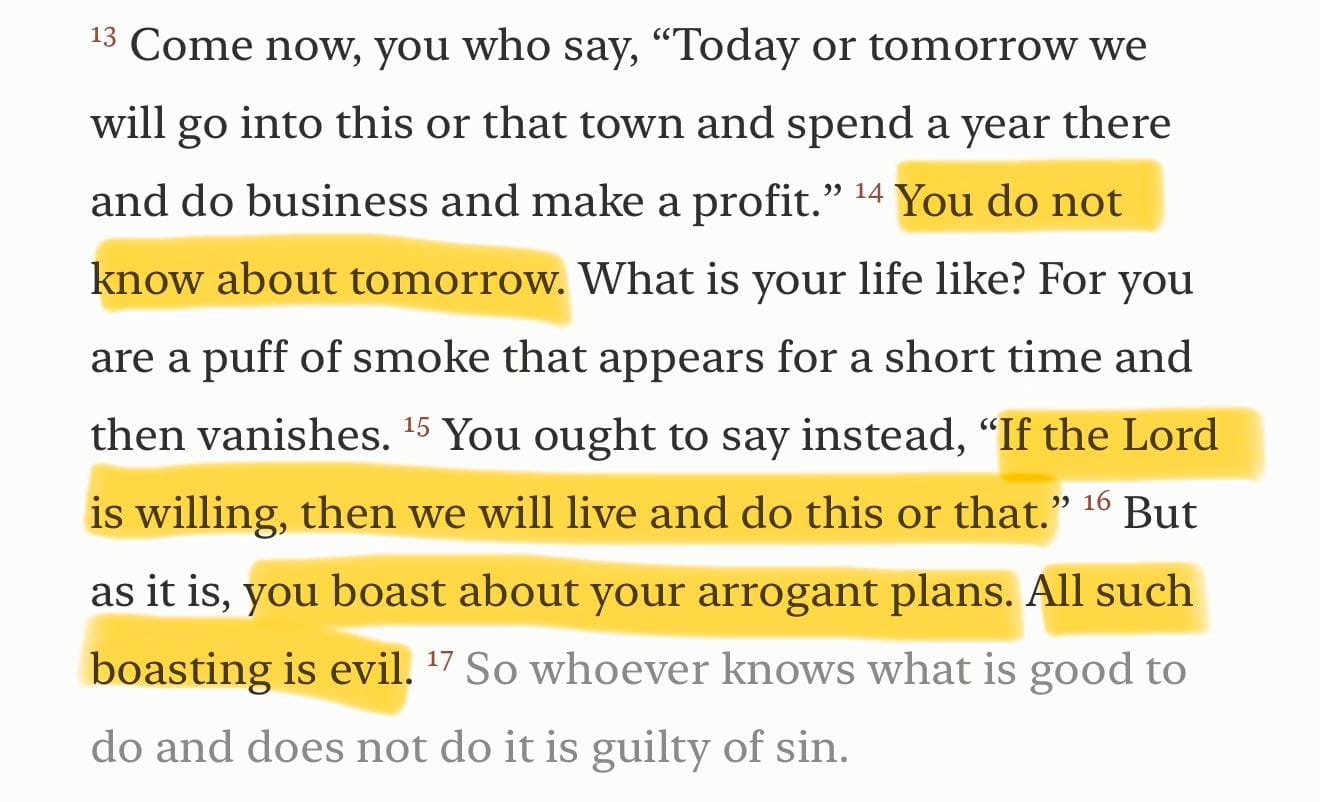
James tells us to submit our plans to God's will, not to stop planning. Indeed, those who know what is good to do and do not do it are guilty of sin.
Submission, then, does not look passive. You do not know whether your plan will succeed. You know that His will. Because of what He did, you know who you are. Because you know who you are, you can do more, stretch further, hit harder, as a steward of a vast and glorious creation.
You are already loved. Spend your life on what that makes possible.
 Meta Tauta LLC